

Customer
BRITA Nordic
Industry
Water treatment
Year
2025
Services
Microsoft 365
BRITA Nordic
If you open the cupboard under the coffee machine in your office, there is a good chance that there is a BRITA filter. BRITA Nordic ensures optimal water quality across the Nordic region.
Challenge: A team of service technicians with a busy everyday life with many tasks and ongoing changes requires an overview that is constantly included.
Solution: A data warehouse collects ERP and operational data in one place and presents it in Power BI reports: a map to the technicians showing where the week's filter change is to be carried out, as well as various relevant information. The Power BI reports also make it easier for the back office to deliver the operational data that BRITA Nordic's customers demand.
Result: The technicians receive task changes in 15 minutes and have all filter information collected in a report, while the chain customers get the information they request.
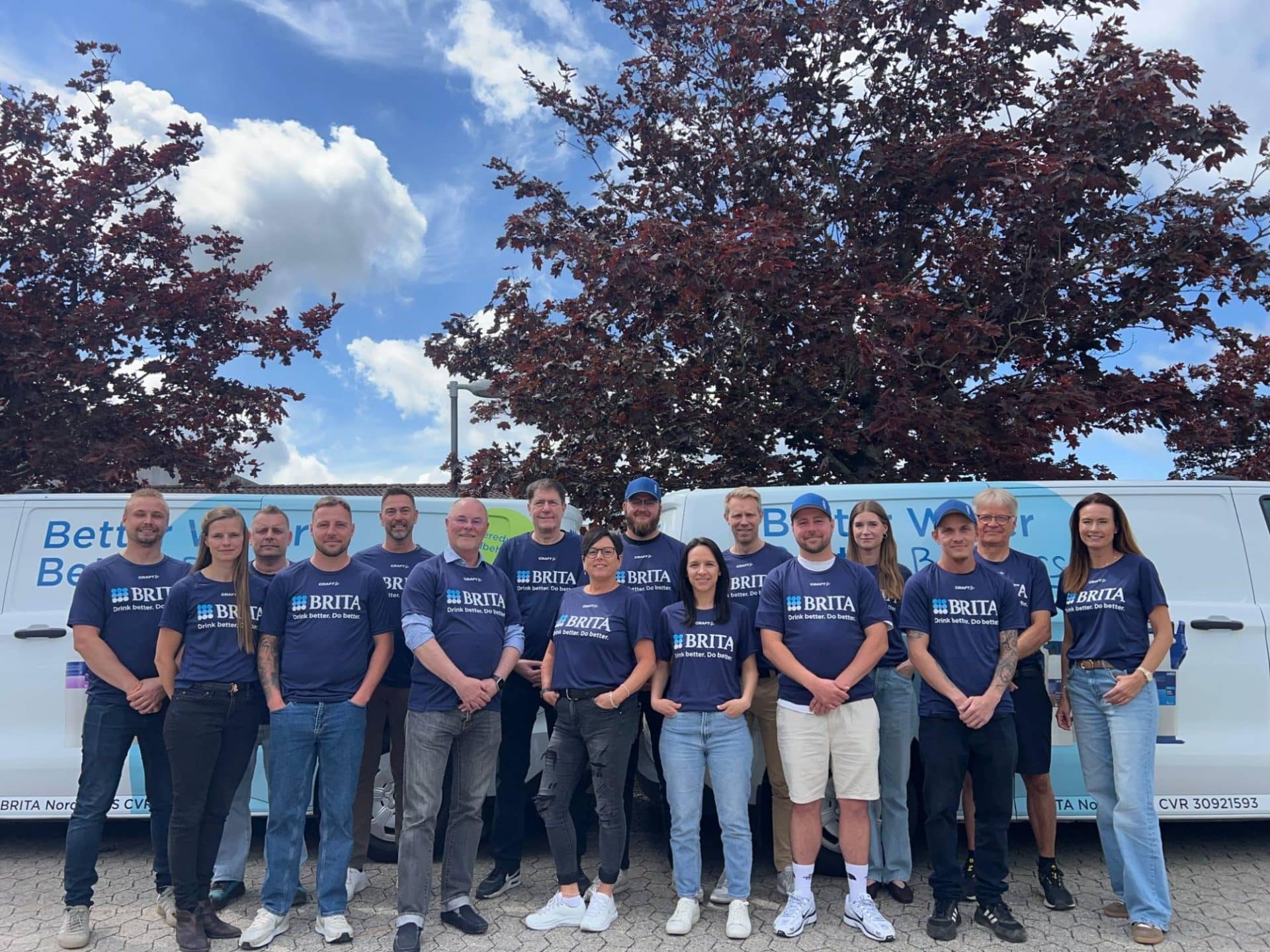
A busy week requires data that can keep up
In Denmark, a team of service technicians takes care of the filter changes at the customers. Behind each filter change is an operational task where plans continuously change and the technicians must have the right information at hand.
Together with KOLLAB, BRITA Nordic has made operating data available in a data warehouse, so that the service technicians via Power BI have access to all the operating data they need. Here, the technicians have, among other things, an updated overview of the week's tasks on a map as well as various lists with information about the week's tasks.
By collecting all operating data in a data warehouse, it has also become easier to share various operating data with BRITA Nordic's customers, so that they get the data they need.
BRITA Nordic is part of the global BRITA group, which works to improve water quality. The filters adapt the water to the machine it will be used in, from coffee machines, ovens and dishwashers to ice machines, and are available at everything from offices, industrial kitchens to large coffee houses.
In Denmark, BRITA Nordic's service technicians ensure filter changes for customers who want it. It is an everyday life where plans continuously change when new tasks are added and others fall away. It is therefore crucial that the technicians always have an up-to-date overview and the right information at hand.
When Lennert Christensen, Managing Director at BRITA Nordic, started five or six years ago, the tasks were sent out by email and followed in Excel, while information about where exactly a filter was located at the customer had to be obtained from the back office.
“When I started, I saw a manual process that needed to be digitized. It was actually such a no-brainer to put digital control on,” tells Lennert, who works at BRITA Nordic.
One unified data base
For BRITA Nordic, it was a clear advantage to collect ERP and data from one business partner and thus have one unified contact. Since KOLLAB was already involved in Business Central, BRITA Nordic's ERP system, it was natural to build on the collaboration.
Together, BRITA Nordic and KOLLAB built one data warehouse, which collects ERP and operational data from Business Central in one place. Every quarter of an hour, new data is retrieved and made available in Power BI, so that the reports are based on a continuously updated data base.
With data gathered in one place, new reports can be built on the existing data base rather than starting over each time.
“There is a completely different flexibility in having all our ERP data and our operating data in a web solution and running it via Power BI,” explains Lennert.
The technicians get new data in fifteen minutes
The technicians have an overview on their iPad, where they can see the week's tasks on a map and plan the route based on where the tasks are. Solved tasks disappear from the map, while the rest of the team's tasks are still visible, so it is easy to coordinate and collaborate along the way.
At the same time, the information on where the individual filter is installed is directly in the report. It provides a better overview and makes the working week easier to plan. When the plan changes along the way, the technicians quickly get the updated overview.
“When you work in an operating organization, there is always something that changes during the week. The fact that we can just update directly in our ERP system and that it makes a breakthrough with the technicians after 15 minutes is a clear advantage and certainly an improvement in our operation.”
Lennert Christensen, Managing Director, BRITA Nordic
Customers get their own data
Because ERP and operating data are combined, BRITA Nordic can also give customers better access to relevant information. Customers have different needs. Some need an overview of when and how the filters are changed, while others focus on water consumption and capacity. With Power BI, the reporting can be adapted to the information that the individual customer needs.
It is supported by BRITA's own digital filter management system, BRITA iQ, which notifies customers when a filter needs to be changed. Consumption data from iQ is in Business Central and is thus also included in the data warehouse.
With BRITA iQ, customers can track their water consumption and see how much capacity is left in the filter, which can be very valuable to the customer, as water treatment is part of their total operating costs, and therefore it is important to be able to document the actual consumption and the need for filter changes.
“This has strengthened the customer relationship,” says Lennert. “It's super cool that we can actually meet them with the information they need.”
The next step in digitization is to send the service report to customers via email rather than on paper. The plan is to digitize the report with a Power App to simplify the process and reduce paper consumption.

Aggregate data provides an overview in the field and with customers
The gain shows in everyday life. The routes are better connected, the plan is always up-to-date, and the technicians have everything they need in one place. Lennert concludes by putting into words where the difference lies:
“We can state that we are really, really effective in the work we do today. This means that we are able to deliver high quality at a low price, which customers greatly appreciate.”
That efficiency rests on one unified data base that works both for the technicians, for the customers and for BRITA Nordic itself. In short, it has given:
■ ERP and operating data in one place
■ Changes at the technicians in 15 minutes
■ All information about the filters in the report
■ Optimizing route planning
■ Relevant data adapted to the individual customer
■ Better overview and easier planning for the technicians
