

AI Agents
Agents working in your own data. Aptean has developed AI agents for Business Central that answer questions, create orders, plan, find reasons for deviations and track batches directly in the data you already have.
The agents work in Business Central and build on your own transactions: item numbers, stock, orders and production orders.
The agents work in standard Business Central, both with and without the food layer from KOLLAB FOOD.
An agent has to move something you can measure
An AI strategy that works rests on three layers. Governance is the foundation: without control over data, users and knowledge, there is neither data consistency, data security nor learning. Influence describes what the agent moves and the action describes how it works. Use the layers as a filter: start in the foundation, find the column the initiative should move, and finally choose how the agent should work.
Read the model from the bottom up: start in governance, move on to influence, and end how the agent should work.
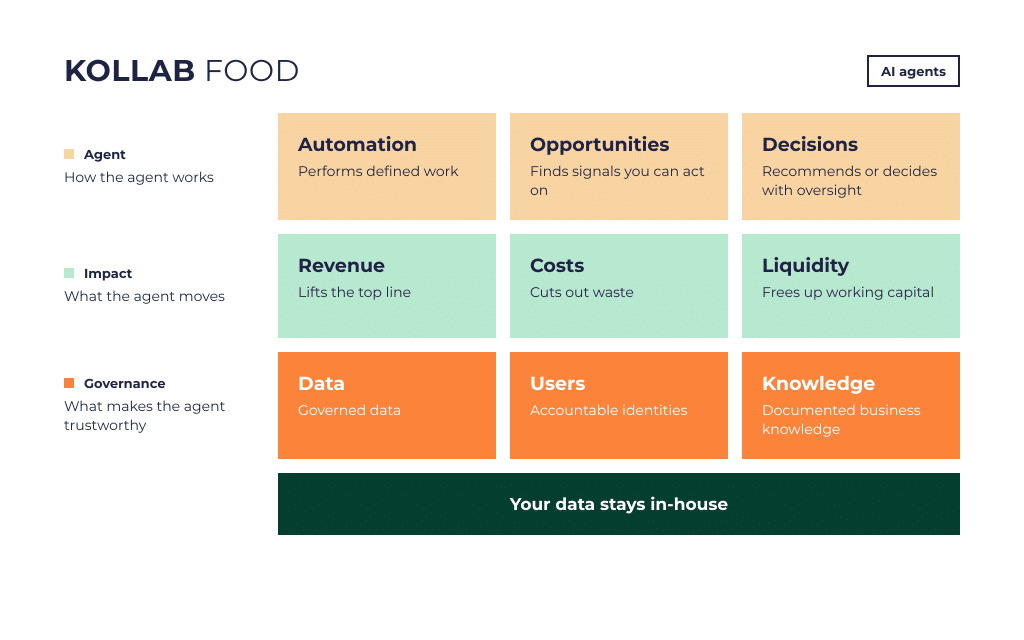
Go through the initiative step by step
Are you considering AI and AI agents in your company? Then the question is about how the initiative returns. The three steps below are the filter that determines whether an initiative is a strategy.
Step 1: Governance
Before an agent can shift revenue, costs or liquidity, it must be safe to put into operation.
Data: quality and origin
- With scattered or unreliable data, the agent repeats the same error on a large scale, automatically.
- Because food requires EU Food Regulation, Article 18, that you can identify your suppliers and the companies you have delivered to and make the information available to the authorities.
- Correct the data foundation before scaling an agent.
Users: identity and access
- Each agent must have his own identity with access limited to the task.
- Create, review and close agents' access in the same way as employees'.
- Decide who is responsible for a fault before the agent is put into operation.
Knowledge: the context of the business
- An agent never gets better than the knowledge it is based on.
- Approvals, exceptions and unwritten workflows also count as knowledge.
- Giving an agent the right basis is often a documentation job before it becomes a technical job.
Data is kept internal: what the agent must see and send
- Governance determines what an agent must see, where it must send it, and what must never leave the organization.
- Suppliers' access, integrations and AI models are assessed according to the same requirements.
- Data becomes internal because the solution is designed that way.
Remember: Don't build on top of a foundation you haven't checked. A quick win on one of the bars can hold a risk that only becomes apparent later, typically at the worst possible time.
Step 2: Impact
If an initiative cannot be linked to at least one of the three pillars with a concrete mechanism, it is not yet a strategy.
Turnover: lifts the top line
- Sales, conversion, retention and new demand.
- Ask: Does it help us sell more, sell faster or keep customers longer?
Costs: cuts away waste and inefficiency
- Waste, working time, rework and inefficiency.
- Ask: Does it cut what we waste today or spend too much on?
Liquidity: free working capital
- Stock, debtors, creditors and timing.
- Ask: Free up the capital that is currently tied up in the business?
The pillars are connected: A more accurate forecast can both cut the waste from surplus stock and free up the capital tied up in it.
Step 3: The action
When an initiative has passed the test, it belongs to one of three categories. The category determines how independently the agent may work and how much supervision it must have.
Automation: performs determined work
- Performs laid-down, repetitive work without a human decision at each step.
- Example: reconciliation of invoices or marking of unusual orders before they leave the warehouse.
Options: find signals you can act on
- Finds trends, gaps, deviations and shifts in demand that a human or other agent can act on.
- The agent points to what is worth looking into, and the decision rests with you.
Decisions: recommends or decides with supervision
- Recommends or makes decisions about, for example, prices, planning and prioritization.
- The more at stake, the more human oversight.
This is how the agents work
- Works with and without the food layer: the agents are based on standard Business Central and work both with and without KOLLAB FOOD
- Use them as they are or as a basis: the agents can be adapted to your own processes
- Agents can call other agents: an agent may use another agent's response as part of his task
- Possibility of own agents: agents can be made for your specific needs
- English: Aptean Intelligence is available in English
- There are always more to come: Aptean continuously develops new agents
Find the agent who moves the most
Fill in the form and we will contact you and have a chat about which agent can move the most in your business.
That requires the AI agents
Aptean's agents come with Aptean Intelligence, which is part of Aptean's AI platform AppCentral. It takes:
- Business Central Premium
- Aptean Intelligence, connected via Model Context Protocol (MCP)
The agents connect directly to Business Central, SharePoint, Teams and Outlook and work within your own environment. Nothing is shared with public AI models.
Microsoft agents in Business Central
Microsoft is also building agents directly into Business Central, including Payables Agent, Expense Agent and Sales Order Agent. The agents work independently. Their work is transparent and can be reviewed, and people are involved in the process. Sales Order Agent, for example, takes care of customers' inquiries by email. The agent is settled in Copilot Credits.


Download the white paper
The white paper on AI agents for the food industry shows where the agents work in Business Central, what they move and what needs to be in place before they make a difference.
In the white paper you get:
■ A model that takes AI strategy and gadgets apart
■ Talk about where the food industry stands with AI
■ Eleven agents in four areas and what they are used for
■ A look at the agents that are on the way
■ A checklist and an idea of how to get started
Have the white paper sent to you
Meet the agents
Eleven agents in four areas. Everyone works directly in your Business Central data. Open an area to see the agents and what they do. For five of the agents, you can also see where they belong in the model and what you can measure them on.
Economics
Answer questions and control the cash flow.
GenAI Query
Ask your data about anything. The agent has access to all your Business Central data. You ask questions in plain language and the agent retrieves the actual data, analyzes it and provides a unified answer, without predefined workflows.
Used for
- Ad hoc searches
- Transversal reporting
- Management reporting
Accounts Receivable
Control receivables. The agent analyzes age-distributed receivables and overdue invoices in real time and shows how your customers pay. It translates raw debtor data into useful knowledge about cash flows.
Used for
- Payment patterns
- Transversal reporting
- Liquidity forecasts
Accounts Payable
Control supplier debt. The agent analyzes age-distributed supplier debt, overdue invoices and cash outflows in real time.
Used for
- Payment analyses
- Utilization of cash discounts
- Suppliers' payment patterns
- Liquidity forecasts
Sales and purchases
Orders and purchases in one interview.
Sales
Orders based on a conversation. The agent finds customer information, checks stock status, verifies prices and creates the order, all from one query.
Used for
- Manual order entry
- Repeated orders
- Offer
- Urgent orders
Purchasing
Procurement in dialogue. The agent analyzes inventory levels, calculates reorder quantities, groups recommendations by vendor, and creates purchase orders.
Used for
- Daily procurement planning
- Manko analyzes for production
- Supplier analyses
- Urgent orders
Planning and storage
The right stock at the right time.
Dynamic Planning & Forecasting
Planning in dialogue. The agent analyzes open orders, inventories, goods receipts, production orders and security inventory in real time, and the planner works with it in a dialogue.
Used for
- Daily planning
- Mankoanalyses
- Planning production orders based on needs
- Goods substitutes
Space in the AI model
- The action: decisions. Recommends or decides with supervision. The more at stake, the more human oversight.
- Impact: primarily costs, also turnover and liquidity.
You can measure that
- Urgent orders and express freight
- Production stoppage due to shortages
- Hours of planning per week
- Back orders for customers
Safety Stock and Lead Time Analysis
The right security warehouse. The agent monitors the security warehouse based on fluctuations in demand and takes into account the durability of date-sensitive goods. It marks items with too low or too high stock and suggests what needs to be done.
Used for
- Dynamic calculation of security stock
- Notification
- Monitoring of goods close to expiry
Space in the AI model
- The action: decisions. Recommends or decides with supervision. The more at stake, the more human oversight.
- Impact: primarily liquidity, also costs and turnover.
You can measure that
- The value of the security warehouse
- Stock days
- Write-downs and discarded goods
- Sold out items
Warehouse & Inventory
Why the warehouse looks the way it does. The agent analyzes inventory, demand, incoming deliveries and consumption history and finds the reason for each shortfall and each profit. The planners see both what is wrong and why.
Used for
- Manko causes
- Surplus stock
- Slowly tradable goods
- Imbalance between supply and demand
Space in the AI model
- The action: opportunities. The agent points to what is worth looking into, and the decision rests with you.
- Impact: primarily costs, also liquidity and turnover.
You can measure that
- Time per stock deviation
- Value of negative inventory adjustments
- Pick error per 1,000 order lines
- Stock accuracy
Production and quality
Reasons for deviations and tracking of lots.
Production Efficiency
Reasons for deviations in production. The agent reviews production orders, material consumption, capacity data and process times and finds over- and under-consumption, yield loss, shrinkage and inefficient processes with a traceable cause analysis.
Used for
- Variance analyses
- Accuracy in recipes
- Validation of process times
- Error in automatic consumption
Space in the AI model
- The action: opportunities. The agent points to what is worth looking into, and the decision rests with you.
- Impact: primarily costs, also liquidity and turnover.
You can measure that
- The value of unexplained deviations
- Material consumption against the planned
- Hourly deviation per production order
- Recipes in tolerance
Production Order Reconciliation
Ready to finish. The agent reviews finished production orders, validates material consumption against the parts lists, reconciles finished product quantities and finds discrepancies so that the orders are ready for completion with less manual review.
Used for
- Completion of production orders
- Reconciliation of consumption
- Variance analyzes before completion
Space in the AI model
- The action: automation. Performs laid-down, repetitive work without a human decision at each step.
- Impact: primarily costs, also liquidity and turnover.
You can measure that
- Production orders completed without corrections
- Time per order completion
- Corrections after completion
- Days to month end
Recall & Trace
Tracking throughout the chain. The agent tracks products throughout the supply chain for recall and quality control purposes. You enter the item and lot number, and the agent tracks backwards through supplier receptions and production and forwards to customers.
Used for
- Recalls
- The customers to be notified
- Quality analyses
- Preparation of audits