

ERP FOR THE FOOD INDUSTRY
Food and beverage companies operate in one of the most complex and regulated markets. The requirements for traceability, food safety, documentation and efficient operation are constantly increasing at the same time as margins are pushed, and customers expect high delivery reliability and uniform quality. This places great demands on ERP for the food industry.
We are specialists in ERP implementations for the food industry, and we know the industry's challenges from the inside out.
Regardless of whether you produce, process or distribute food, your processes are complex and sector-specific. A generic ERP solution does not solve them. With Aptean Food & Beverage on the Microsoft Dynamics 365 platform, you get a tailored solution that covers approx. 90% of your standard and industry processes from day one.
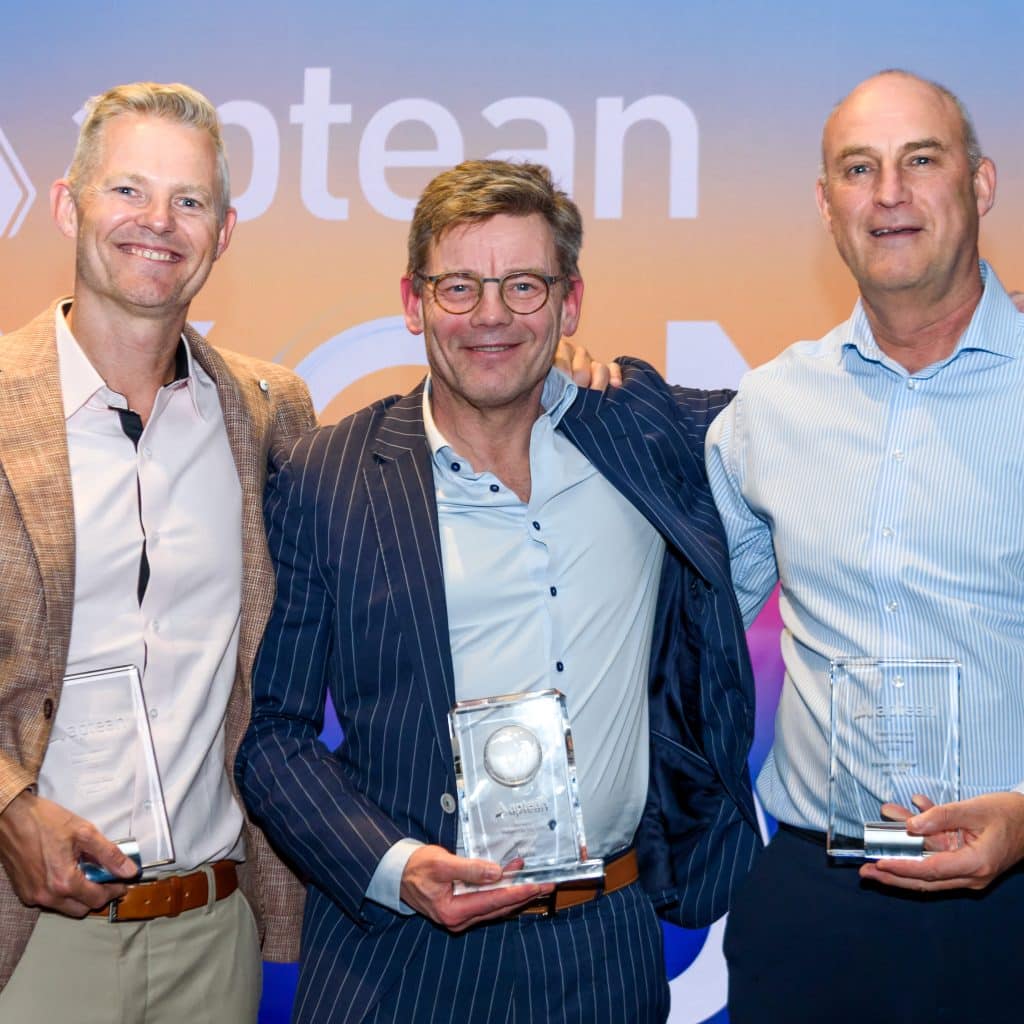
BEST APTEAN PARTNER IN EUROPE 2025
We have been named Best Aptean Partner in Europe 2025. A recognition we are both humbled by and proud of – and at the same time confirm that our targeted focus on Food & Beverage creates real business value.
The award reflects our uncompromising approach to quality, our close collaboration with customers and our ability to translate complexity into scalable, value-creating solutions.
A big thank you to Aptean, our customers and employees who have helped make it possible. We look forward to speeding up Food & Beverage even more.
Time for a comprehensive solution
Many companies struggle with system landscapes that have grown over time:
- Several separate IT systems that do not talk to each other
- Manual workflows and Excel sheets as load-bearing operating elements
- Lack of overview of stock, batch, durability and production
- Difficult documentation for audits, certifications and authority requirements
The result is often waste, inefficiency and business uncertainty, but with the right ERP platform, complexity can be turned into a competitive edge.
Typical challenges in the industry
Food and beverage companies share many of the same fundamental challenges whether they produce, process or distribute. The common denominator is high complexity, tight requirements and the need for constant control.
Below are some of the most pervasive challenges we see in the industry:
Lack of end-to-end traceability
Traceability is no longer a competitive parameter, but has over time become a legal requirement and a prerequisite for being able to run a professional food business. Yet many companies find that it is both time-consuming and unsafe to track raw materials, semi-finished and finished goods across purchasing, production, warehousing and distribution.
When data is distributed over several systems – or handled manually in spreadsheet –, challenges typically arise such as:
- Lack of overview of which raw materials are included in which products
- Uncertainty about batch and lot contexts
- Slow and risky handling of product recalls
- Difficult documentation for customers, authorities and certification bodies
The consequence is increased business risk, higher costs and constant pressure on the organization when something goes wrong.
Short durability and complex storage
Many food and beverage companies work with goods with a short shelf life, varying quality and different origins. At the same time, FEFO principles, batch control and variable weight (catch weight) place high demands on both warehouse and production management.
Without an ERP system built for these very conditions, companies often experience:
- Outdated or imprecise stock data
- Lack of connection between physical storage and system records
- Unnecessary waste as a result of expired or misplaced goods
- Difficulties in planning production from real available stock
It affects not only costs, but also delivery reliability and customer satisfaction.
Production with many varieties, recipes and changes
Food production is rarely simple. Recipes, ingredients, allergens, packaging and product variants must be precisely controlled and often changes are made to composition, suppliers or production parameters on an ongoing basis.
Small changes can have major consequences if they are not handled correctly:
- Incorrect labeling or lack of allergen information
- Non-uniform quality from batch to batch
- Increased waste and rework in production
- Deficient calculation and uncertain earnings
Without a single system for recipe and production management, it will be difficult to ensure both quality, efficiency and overview.
Increasing requirements for quality, documentation and compliance
The requirements for food safety, quality and documentation will only be stricter. Certifications, audits and legislation require documentation.
Still, we see many companies where quality data:
- Registered manually or in separate systems
- Are difficult to assemble across processes
- Only found when audits or authorities knock on the door
This means that employees spend an unnecessary amount of time looking for information, instead of working proactively with quality and improvements.
ERP for the food industry
An ERP system developed specifically for the food industry
When food companies search for an ERP system, it is rarely about standard functions. It's about finding a solution that can handle traceability, durability, quality, documentation and complex production without creating more manual workflows.
Aptean's ERP solution for the food industry is built on Microsoft Dynamics 365 Business Central and expanded with industry-specific functionality that supports the entire value chain in food and beverage production. This makes the solution suitable for both producers, processors and distributors.
One unified ERP basis for storage, production and quality
Many companies today use several systems for storage, production, quality and documentation. This creates data breaches, uncertainty and a lack of overview.
With a food-adapted ERP solution, these processes are brought together in one integrated Business Central environment, where data is shared across departments. It provides better consistency between stock status, production planning, quality requirements and finances and reduces the need for manual controls.
ERP with built-in traceability and compliance
In the food industry, traceability and compliance are not optional, but prerequisites for being able to do business. An ERP system without food logic makes traceability a manual discipline.
Aptean's solution is designed to support traceability in food production as an integral part of daily processes. This means that documentation, batch contexts and history are built up automatically in the system and are always available for audits, customer requirements and authority control.
Better decision-making basis in an industry with low margins
Food companies often work with low margins and high complexity. Small errors in planning, pricing or inventory management can have major financial consequences.
With an ERP system targeted at the food industry, the company gets access to updated and consistent data that supports better decisions about procurement, production, capacity utilization and deliveries based on facts.
Scalable ERP for both national and international food companies
Regardless of whether the company operates locally or across countries, food production requires flexibility in the ERP system. Multiple currencies, languages and corporate structures significantly increase complexity.
Business Central combined with Aptean's food functionality provides a scalable ERP foundation that can support growth, new markets and changing business models without the system needing to be replaced.
Apteans ERP for the food industry
Aptean Food & Beverage ERP Enterprise Edition is a complete end-to-end ERP system designed for food manufacturers, breeders and distributors. The solution is built on Microsoft Dynamics 365 Business Central and has been developed specifically for industry requirements for traceability, quality, compliance and efficiency supply chain management throughout the supply chain.
Inventory management & product dimension management
Detailed stock control gives you a full overview of stock down to variant, quality, country of origin, packaging, breed, cut and age. It ensures accurate stock status in real time and better planning across purchasing, production and sales.
Example in practice:
A food producer can see exactly which batches of beef are in stock, broken down by cut, age and country of origin, and ensure that the oldest items are used first, while meeting customer requirements for origin and quality.
Traceability & food safety
With end-to-end traceability, you can follow ingredients and finished products throughout the supply chain, both backwards and forwards. It provides quick response to recalls and strong documentation for audits and authorities.
Example in practice:
In the event of a quality deviation, the company can identify all affected batches in a few minutes, which customers received them and which raw materials were used without manual spreadsheets or time-consuming lookups.
Quality management and allergen administration
The system supports advanced quality control with automated tests, quality checks and documentation throughout the process. Allergen and nutritional information is centrally controlled and linked directly to products and batches.
Example in practice:
If a recipe contains allergens, the system automatically ensures correct labeling and warnings and prevents products with undeclared allergens from being sent further into production.
Ingredients & BOMs with intelligent substitutions
Aptean provides full control over ingredients, BOM (BOM) and recipes. Intelligent substitutions make it possible to replace raw materials without compromising on quality or traceability.
Example in practice:
If a particular raw material is not available, production can continue with an approved alternative ingredient while cost price, allergens and traceability are automatically updated.
Grower and producer management
The solution brings together management of growers and producers in one system. Contracts, consignment stock, batch profitability and settlement are handled together and transparently.
Example in practice:
A company can settle growers correctly based on actual quality, weight and price per batch while creating an overview of profitability per supplier.
Customer and item lists
Customer-specific product and price lists ensure that each customer gets the right products, prices and conditions every time.
Example in practice:
A wholesaler can set up different ranges and prices for retail chains, foodservice and export customers, without the risk of sending incorrect items or prices.
Forecasts & purchase agreements
Collaborative forecasting makes it possible to plan production and purchases based on history, seasonal fluctuations and customer agreements and not gut feelings.
Example in practice:
The company can plan the purchase of raw materials for high season based on expected orders and contracts and thus reduce both waste and urgent purchases.
Trading Board & trade management
The trading board provides an overall overview of purchases, sales, market prices and contracts in real time.
Example in practice:
Purchasing and sales departments can quickly respond to price fluctuations in the market and enter into agreements that maximize margin without losing an overview of inventory and logistics.
Logistics & transport management
Advanced logistics functionality supports cross-docking, mixed pallets and return packaging, making distribution more efficient and cost-effective.
Example in practice:
Goods can be transhipped directly from incoming to outgoing transport, so that delivery times are shortened and storage costs are reduced.
Mobile data collection & EDI
Mobile data collection provides real-time recording directly from storage and production, while EDI automates the exchange of orders, delivery notifications and invoices.
Example in practice:
A supplier receives orders electronically via EDI, and employees register goods receipt on the mobile without manual entries or errors.
Entry & touch screen solutions
Touch screen solutions make it easy for production and warehouse workers to record data quickly and correctly, even without ERP expertise.
Example in practice:
At the production line, output, quality and waste are recorded directly on a touch screen, so that management always has updated key figures in real time.

Course on Coast
KYST faced extensive manual typing, poor product traceability and fragmented handling of attributes, attachments, inventory management, label management and payments, creating waste of resources, low visibility and hampering the company's ability for efficient operation and growth.
With a food-specific ERP solution, KYST has set the course for internal workflows towards a more manageable and overview-forming control system.




FAQ
Are you considering an ERP system for the food industry? Here we answer the most central questions that decision makers typically ask in the purchase process.
What are the advantages of an ERP system for the food industry?
An ERP system for the food and beverage industry collects data across the entire company, so you get one unified basis for planning, production, storage, quality and compliance. You get, among other things:
- One unified data source (“single source of truth”)
- Traceability both forward and backward in the supply chain
- Strengthened food safety and compliance
- Better inventory management and less waste
- Increased efficiency, flexibility and profitability in a dynamic industry
Why do food companies need an industry-specific ERP?
Standard ERP without specific functionality for food often lacks tools for e.g. catch-weight, batch management, recipe management and ingredient tracking: functions that are essential in food production. Therefore, an industry-specific system like Aptean is better equipped to solve the unique challenges in the industry.
Which departments can benefit from an ERP system?
An ERP system for the food industry is used across the entire company. This applies to most processes from production, storage and logistics to sales, purchasing and finance. It creates one common information base for both production workers and management.
Which functions should a food ERP prioritize?
The main features often mentioned for food ERP include:
- Traceability from raw materials to finished goods
- Stock control with real-time and FEFO control
- Recipe and form management
- Automation of quality control and compliance checks
- Allergen management and preparedness for recalls
- Demand forecasts and planning
- Economic analysis and visualization for better profit management
How is an ERP system implemented?
ERP systems for the food industry can be implemented as cloud-based (Software-as-a-Service) or on-premise. Cloud solutions often have lower initial costs, increased flexibility and higher uptime, while on-premise can be relevant for special IT requirements. Regardless of the solution, the implementation requires time, planning and internal anchoring.
Do employees need training?
Yes – as with any major system change, there will be a need for training so that employees can make optimal use of the system. The advantage of an industry-specific ERP is that the user interface is often more intuitive for people who already use Microsoft tools like Office and Outlook.
What can you expect from ROI (Return on Investment)?
What can you expect from ROI (Return on Investment)?
It is difficult to put a concrete number on ROI, but ERP systems can improve operational efficiency, order fulfillment, planning security and data quality. Results that typically lead to lower costs, fewer errors and a better bottom line over time. Many companies experience improved productivity and reduced waste within the first year.
How should the company prepare for an ERP project?
Before implementation, the company should:
- Define the purpose and objectives of ERP
- Map critical processes
- Bring together an internal project group
- Evaluate system requirements and suppliers carefully.
An ERP project is an investment in future efficiency and requires time, commitment and clear communication.
Can ERP be integrated with other systems in the company?
Yes, most ERP systems can be integrated with other business systems. However, it is important to avoid expensive, custom-built integrations that could complicate future upgrades. Solutions such as Aptean often offer a unified ecosystem that minimizes the need for heavy adaptations.
What should be expected from the supplier?
A good ERP supplier not only works as a software seller, but as partner through implementation and operation. This means advice, support and industry expertise, so that the system continuously develops in line with the company's needs.